
Streak Habit Tracker
Add up to eight habits, tick the days you did them, and the tracker works out your current streak, your best streak and how consistent you have been over the last 30 days. Everything stays in this browser on this device.
- Free to use
- No sign-up
- Runs in your browser
Your habit streaks
Your habits are saved only in this browser's local storage so they survive a page reload. Nothing is sent to a server. Export a backup before clearing browser data or switching devices.
Habit Streak Printable Pack
Printable and spreadsheet versions of the streak tracker for people who like paper, or who want a full year of history in one file.
- Year workbook (XLSX)
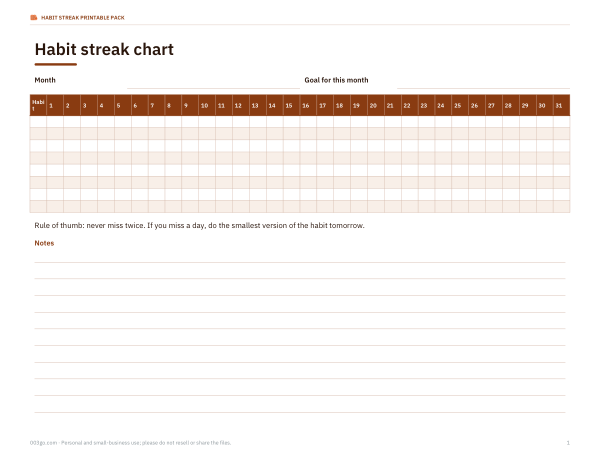
- 31-day streak chart (PDF, DOCX)
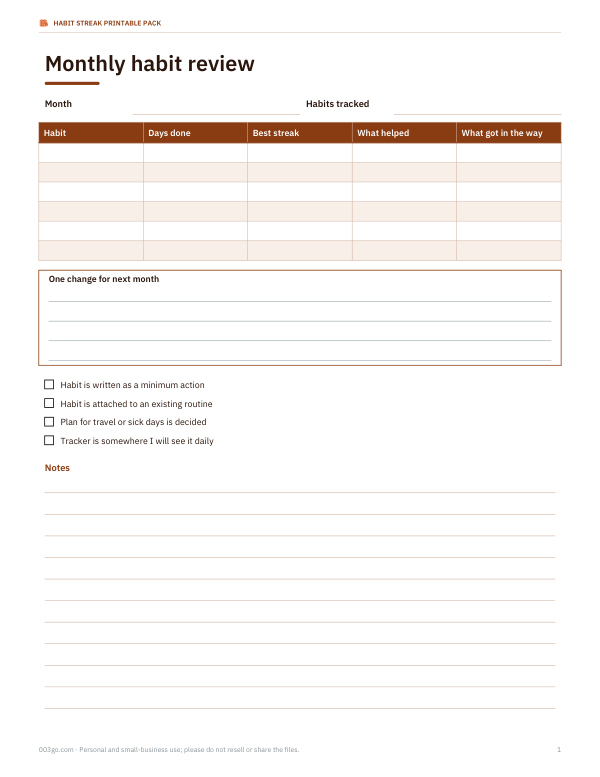
- Monthly habit review sheet (PDF, DOCX)
Formats: XLSX, PDF, DOCX. Instant download after payment (link valid 72 hours, up to 5 downloads). AI-assisted: the templates were drafted with AI help and reviewed and laid out before publishing.
$4.00 USD, one-time 3 files · about $1.33 each
- Instant download
- 7-day refund
- Secure checkout by Stripe
7-day money-back guarantee. Full refund within 7 days of purchase, even after you download.
Full refund within 7 days — see the refund policy and license.
Free printables
Single sheets you can print right now, no sign-up. The full pack adds every sheet in one download plus the editable files.
How the streak tracker works
A streak is the number of consecutive days on which you completed a habit. This tracker counts backwards from today: if today is already ticked, today counts; if it is not ticked yet, the count starts from yesterday so your streak does not look broken before the day is over. The moment a day in the chain is missing, the count stops.
Three numbers appear for every habit. Current streak is the unbroken run ending today or yesterday. Best streak is the longest run anywhere in your history, so a single missed day never erases what you achieved before. Last 30 days is the share of the past thirty calendar days you ticked, which is often the more honest measure of progress because it rewards getting back on track.
A habit is highlighted when it has a live streak but today has not been ticked. That is your cue to do the small version of the habit before bed rather than lose the chain.
Setting up habits that are easy to tick
Streak tracking works best when each habit has a clear yes-or-no finish line. “Exercise more” is hard to score; “walk for 20 minutes” or “do 10 push-ups” is easy. Write the habit name as the minimum action that counts, then treat anything extra as a bonus.
- Make it specific: “Read 10 pages” instead of “read”.
- Make it small enough for a bad day: two minutes of stretching still counts as stretching.
- Attach it to something you already do: “after coffee, write three sentences in my journal”.
- Track fewer habits well: three to five habits are easier to sustain than eight.
- Decide in advance what happens on travel days, illness or holidays, so you do not argue with yourself later.
If a habit is not meant to be daily — the gym three times a week, for example — track the smallest daily supporting action instead, such as “pack gym bag” or “ten minutes of mobility work”, or read the 30-day percentage rather than the streak.
Reading your streaks without getting discouraged
Streaks are motivating because you can see the chain growing, but they can also become fragile: after a long run, one missed day can feel like failure. Research on habit formation suggests an occasional miss does little damage. In a well-known study by Phillippa Lally and colleagues at University College London (2010), participants took on average 66 days for a new behaviour to feel automatic, with a very wide range from 18 to 254 days, and missing a single opportunity did not materially affect the process.
A practical rule many people use is “never miss twice”. A single gap is an accident; two in a row is the start of a new pattern. That is why the tracker shows your best streak and your 30-day rate next to the current streak: the long-run record is still yours after a gap.
| What you see | What it usually means | What to try |
|---|---|---|
| Current streak grows, 30-day rate above 85% | The habit is settling in | Keep the minimum small; do not add difficulty too fast |
| Frequent single gaps, rate 60–85% | The habit fits most days but not all | Look for the day of week you miss and plan a lighter version |
| Streak rarely passes 3 days | The habit may be too big or badly timed | Shrink it or move it next to a routine you never skip |
| Long streak then several empty days | A disruption such as travel or illness | Restart with a one-day goal; your best streak is still recorded |
Worked example
Suppose you started “Walk 20 minutes” on the 1st of the month and ticked every day through the 12th, missed the 13th, then ticked the 14th to the 20th. On the 20th, before you walk, the tracker shows a current streak of 6 (the 14th to the 19th), a best streak of 12, and a 30-day rate of 19 out of 30 days, about 63%, because the days before the 1st are empty. After you walk and tick the 20th, the current streak becomes 7.
If you forget to tick a day but did the habit, move the date selector back — the grid shows any 14-day window — and tick the day you missed. Future dates are locked so a streak cannot be pre-filled.
Keeping your data safe
The tracker stores habits in your browser's local storage on this device. There is no account and nothing is uploaded, which also means your data does not sync between your phone and computer. Use Export backup to save a small JSON file, and Import backup on another device or after clearing your browser. Private or incognito windows usually delete local storage when they close.
The Print blank 31-day chart button produces a paper version with your current habit names, useful for a fridge or desk where a physical chain of crosses is hard to ignore.
Paper chart or digital tracker?
Both work, and many people use both. A paper chart is always visible and satisfying to mark, but it cannot calculate your best streak or 30-day rate, and a full page can hide gaps. The digital grid calculates everything instantly and keeps months of history, but it is only as visible as the tab you open. Pinning this page or adding it to your phone's home screen gives you one tap to tick the day.
Frequently asked questions
Does missing one day reset my best streak?
No. Your current streak restarts, but your best streak keeps the longest run you ever recorded, and the 30-day percentage only drops slightly.
Why does my streak not include today?
Today only counts once you tick it. Until then the streak is counted to yesterday, so it is not shown as broken during the day.
Can I track a habit that is not daily?
Yes, tick the days you do it and use the 30-day rate as your score. The streak number is designed for daily habits.
Where is my data stored?
Only in this browser's local storage. This site does not receive or store your habits. Export a backup file if you want a copy.
How many habits can I track?
Up to eight, so the grid stays readable on a phone. Most people find three to five is the sweet spot.
Can I print it?
Yes. The print button creates a blank 31-day chart with your habit names; your browser can also save it as a PDF.